🧠

What is Deep Linking?

The comprehensive guide to mobile app routing, Universal Links, and how direct app launching transforms user engagement.

No login required • Free with analytics
⚡ Sub-100ms redirects 🛡️ Zero forced ads 📊 Real-time analytics
Last updated: May 1, 2026

How It Works

Four simple steps to bypass mobile browser previews and boost your engagement.

1

Standard links open websites; deep links open apps

2

OS recognizes registered app URI schemes

3

Clicking launches the app to a specific screen

4

Users bypass web logins and engage instantly

The Foundation of Mobile Growth

Learn how to bridge the gap between the mobile web and native applications.

Before (Standard Link) https://www.netflix.com/title/80014749
After (Smart Link) https://linkyt.in/netflix-show-demo
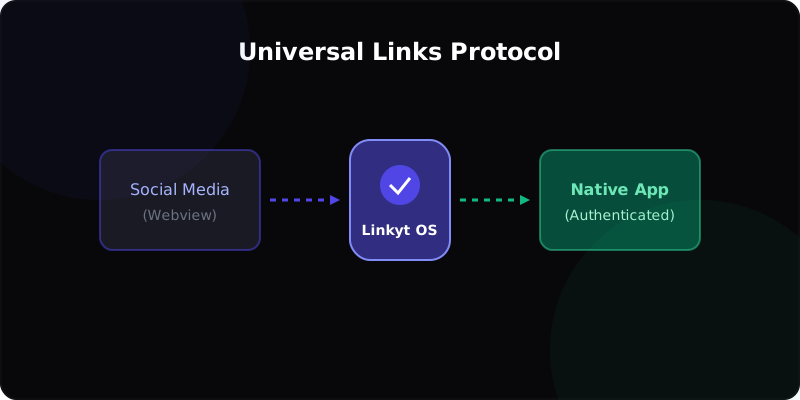
What is Deep Linking? Workflow Diagram

Why Use Our Smart Links?

Experience the premium advantages of native deep linking architecture.

Seamless app-to-app user navigation
Dramatically higher conversion rates
Essential for mobile growth strategies
Preserves user authentication
Eliminates webview friction

Who Is This For?

Built for professionals and creators who care about maximizing every single click.

💡 E-commerce Product Sharing 💡 User Onboarding Flows 💡 Content Distribution 💡 Transactional Emails 💡 Retargeting Campaigns

The Fundamentals of App Routing

In the early days of the web, a deep link simply meant linking to a specific page rather than a homepage. Today, mobile deep linking refers specifically to the technology that directs a user to a specific screen inside a native mobile application, bypassing the web browser entirely.

This relies on the operating system acting as a traffic director, recognizing registered URI schemes (like twitter://) and launching the appropriate software package.

Why Deep Linking is a Business Imperative

Users spend disproportionately more time inside native apps compared to mobile browsers. Native apps offer superior UI/UX and crucial persistent authentication (users stay logged in).

When you force a user to view content in a mobile browser, you strip away that authentication, drastically reducing the likelihood they will purchase or engage. Deep linking bridges this gap, creating a frictionless journey that increases conversion metrics by multiple factors.

Frequently Asked Questions

Everything you need to know about smart app routing and deep linking.

Q: What is the difference between URI schemes and Universal Links?

URI schemes were the first generation of deep linking but lacked fallbacks (they broke if the app wasn't installed). Apple's Universal Links are secure HTTPS links that open the app if installed, but degrade gracefully to a webpage if not.

Q: Is deep linking only for mobile apps?

Historically yes, but the concept is expanding. Desktop operating systems (like macOS and Windows) now support similar intent-based routing to open desktop applications (like Spotify or Slack).

Q: Do I need a developer to implement deep links for my marketing?

No. Tools like Linkyt abstract all the technical complexity. You simply paste a standard web URL, and the tool generates a smart deep link ready for deployment.

Q: Can deep links pass data to the app upon installation?

Yes, this specific concept is called "Deferred Deep Linking," where context is preserved through the App Store installation process and delivered to the user upon first launch.

Explore Related Tools

Boost your link management and creator architecture with our full suite of tools.

Create your first smart link — it takes seconds.

Home Creator Support Sign In
Linkyt